


 Støt Socii.dk 💸
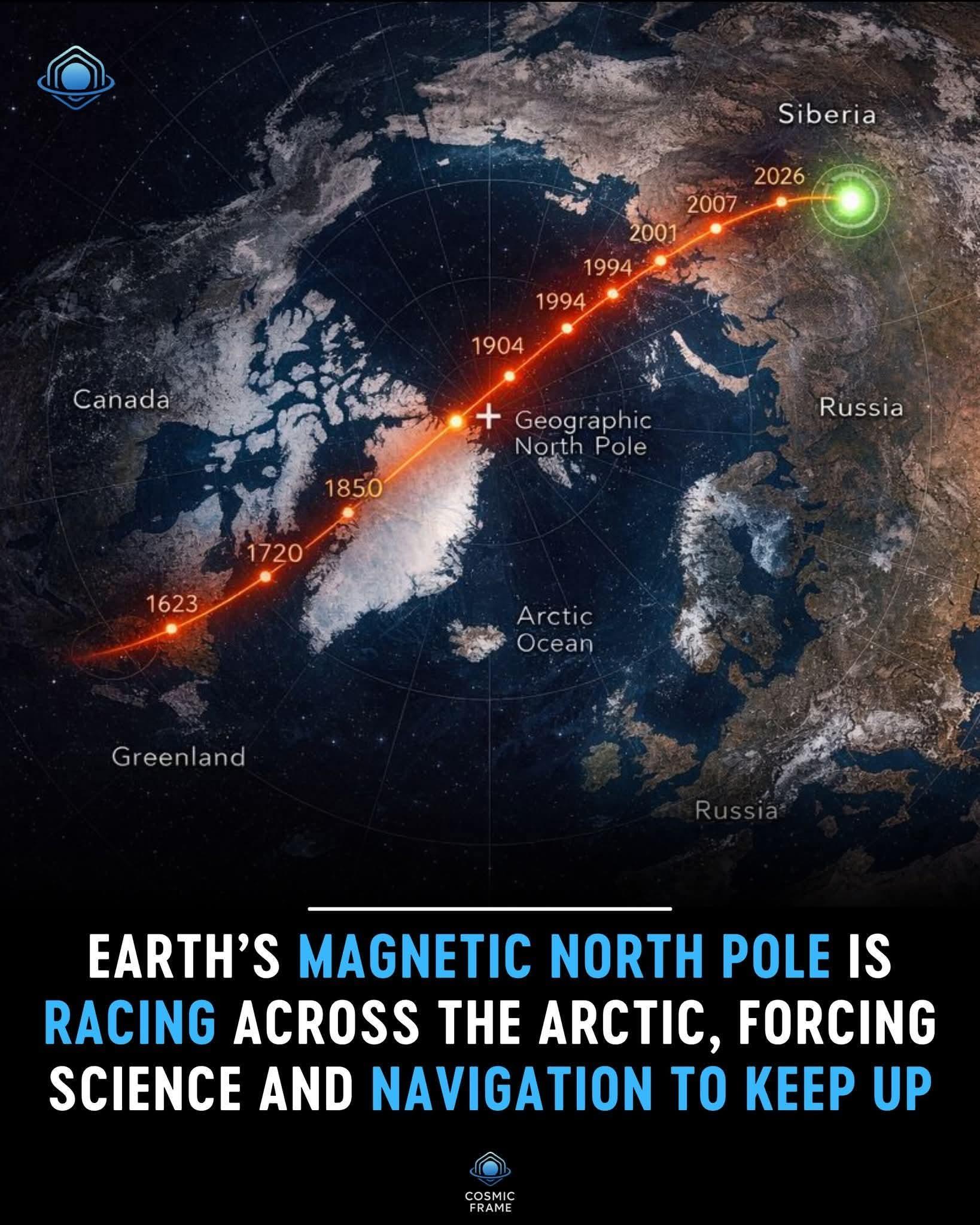
Earth’s Magnetic North Pole is not fixed like the geographic pole. For over four centuries, it drifted slowly from northern Canada toward Siberia, but during the late twentieth century its movement accelerated dramatically, reaching speeds of more than 50 kilometers per year.
Scientists link this rapid motion to changes deep inside Earth’s outer core, where flowing molten iron generates the planet’s magnetic field. Shifts in these powerful currents, particularly beneath Siberia, altered the balance of magnetic forces and pulled the pole faster across the Arctic.
Although the pace has recently slowed to about 35 kilometers per year, the movement still matters. Navigation systems, aviation charts, satellites, and even animal migration rely on accurate magnetic models. Updated data from agencies like NOAA and NASA help keep modern technology aligned with a planet that is constantly changing.
Source/Credit: Geomagnetic research; NOAA and NASA magnetic field studies
Scientists link this rapid motion to changes deep inside Earth’s outer core, where flowing molten iron generates the planet’s magnetic field. Shifts in these powerful currents, particularly beneath Siberia, altered the balance of magnetic forces and pulled the pole faster across the Arctic.
Although the pace has recently slowed to about 35 kilometers per year, the movement still matters. Navigation systems, aviation charts, satellites, and even animal migration rely on accurate magnetic models. Updated data from agencies like NOAA and NASA help keep modern technology aligned with a planet that is constantly changing.
Source/Credit: Geomagnetic research; NOAA and NASA magnetic field studies
Earth’s Magnetic North Pole is not fixed like the geographic pole. For over four centuries, it drifted slowly from northern Canada toward Siberia, but during the late twentieth century its movement accelerated dramatically, reaching speeds of more than 50 kilometers per year.
Scientists link this rapid motion to changes deep inside Earth’s outer core, where flowing molten iron generates the planet’s magnetic field. Shifts in these powerful currents, particularly beneath Siberia, altered the balance of magnetic forces and pulled the pole faster across the Arctic.
Although the pace has recently slowed to about 35 kilometers per year, the movement still matters. Navigation systems, aviation charts, satellites, and even animal migration rely on accurate magnetic models. Updated data from agencies like NOAA and NASA help keep modern technology aligned with a planet that is constantly changing.
Source/Credit: Geomagnetic research; NOAA and NASA magnetic field studies


 English